
More and more people are turning to AI chatbots to make sense of their divorce, whether to understand the process, draft a message to a spouse, or estimate what a fair settlement might look like. Used carefully, AI in divorce can help you feel better prepared. Used as a substitute for legal advice, it carries real risks.
AI in Divorce Can Invent Case Law: The Risk of Fake Legal Citations
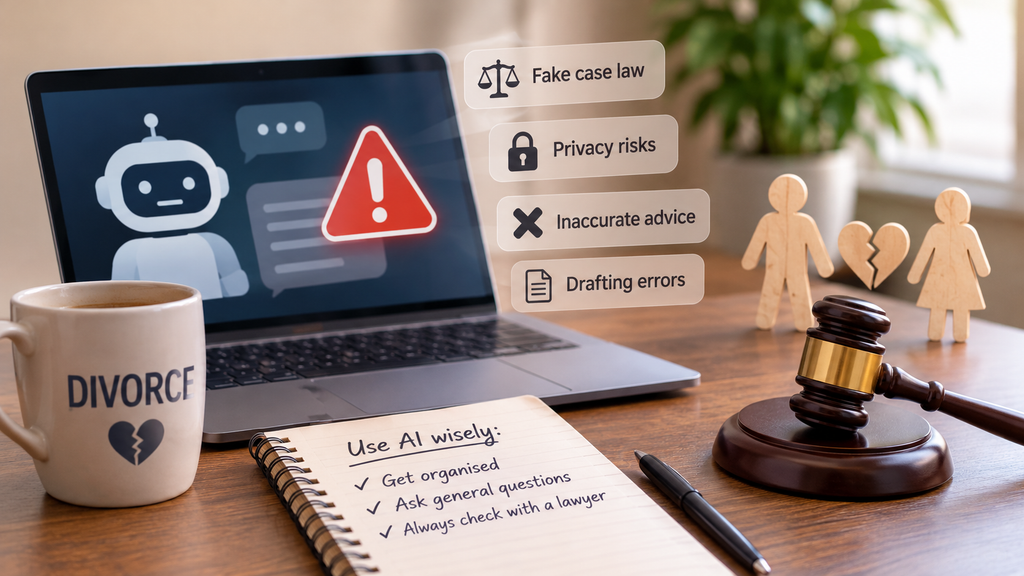
Generative AI tools can produce confident, convincing and entirely fictitious legal authorities. The High Court has warned that these tools “are not capable of conducting reliable legal research” and can give answers that are “entirely incorrect” (Ayinde v London Borough of Haringey [2025] EWHC 1383 (Admin)). The Family Court has already dealt with AI-generated fake citations in children proceedings (Re A, B, C, D (Extension of Assessment; Use of AI: Hallucinations) [2026] EWFC 71 (B)), and the Solicitors Regulation Authority has issued a warning notice on the misuse of AI. If you rely on an invented authority, the consequences fall on you.
Why AI Doesn’t Know Your Divorce Case
AI works from general patterns. It doesn’t know how your court or judge approaches an issue, can’t weigh credibility, and can’t spot gaps in the other side’s disclosure. Divorce outcomes turn on the specific facts, and a polished answer can create false certainty, particularly where children, abuse allegations or complex finances are involved.
Is Your Information Private When You Use AI for Divorce?
Many AI platforms store what you type and may use it to train their models. Family cases involve some of the most sensitive information a person holds, including finances, health details and information about children. Anything generated with AI in connection with your case could also potentially be sought in disclosure, so treat it with the same care as an email or text message.
The Problem with AI-Drafted Divorce Documents and Messages
Divorce settlements and child arrangements are legally binding and hard to undo once approved by the court. An AI-drafted clause may look polished while missing something essential, such as how a pension is dealt with. Messages to a spouse written by AI can also read as cold or adversarial, which can escalate conflict rather than help resolve it.
How to Use AI in Divorce Sensibly
AI can be useful for organising documents, preparing questions before a consultation and explaining general terms in plain language. It should not be used to get legal advice, to draft anything going before the court, or to share sensitive details about your case. Always have a solicitor check anything it produces.

What to Do If You Have Already Used AI in Your Divorce
If you have already used an AI tool in connection with your divorce, you have not necessarily done any harm, but it is worth being open about it. Tell your solicitor what you used it for and share anything it produced, so that it can be checked before it is relied on. Do not put anything it has drafted in front of the court or send it to the other side without legal advice. If you entered sensitive details, check the platform’s privacy settings and avoid sharing further information about your case. And if you are unsure whether something it told you is accurate, ask your solicitor before acting on it.
When to Speak to a Family Solicitor
AI can help you get organised, but there are points in a divorce where advice from a solicitor matters most: when you are agreeing how finances, pensions and the family home will be divided, when arrangements for children are being discussed, and when anything is going to be put before the court. A solicitor can explain how the law applies to your circumstances, check documents before you rely on them and help you avoid decisions that are difficult to undo.
If you are going through a separation or divorce and would like advice tailored to your circumstances, please get in touch with our family law team.
The contents of this post do not constitute legal advice and are provided for general information purposes only ■